
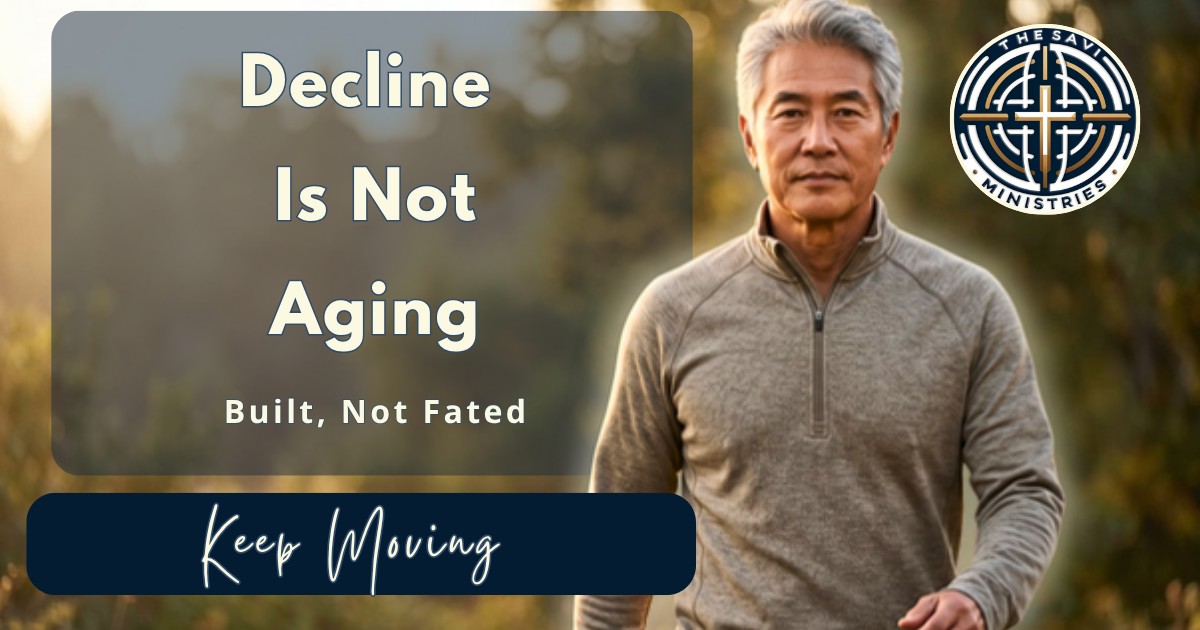
Decline Is Not Aging
A quiet belief takes hold: that fatigue, creeping weight, and a growing medication list are simply what getting older feels like.
Somewhere in adulthood a quiet belief takes hold: that the fatigue, the creeping weight, the shorter breath on the stairs, the slowly lengthening list of medications are simply what getting older feels like. We inherit the idea long before we ever examine it, and so we rarely do. But it deserves examination, because it may be the most expensive assumption most of us never question. If decline is simply age, there is nothing to do but brace for more of it. If decline is mostly conditions, almost everything is still open. Decline is not aging. Much of what we blame on the years is really the accumulated cost of how we have been living.
Last week we saw that many modern symptoms are misalignment, not malfunction. This week we name the larger illusion underneath that, the belief that chronic decline is simply the price of time, look at what the evidence says is actually driving it, and at the most hopeful part of all, how often it can be turned around. This is the opening argument of The Health Protocol's first chapter.
Common is not the same as natural
The body has barely changed in a century. The world it lives in has changed beyond recognition. When biology stays roughly the same while health steadily worsens, the cause cannot be biology or time; it has to be the environment, the food, the light, the movement, the stress we now live inside. The book makes the distinction sharply: common does not mean natural, and frequent does not mean inevitable. To treat a widespread pattern as a law of life is to mistake a pattern of exposure for human design. Most of what we have learned to accept as normal aging is, on closer look, normalized drift.
Diseases that arrive slowly
Part of why the illusion holds is that these conditions do not announce themselves. The infections that once killed people arrived fast and visibly. What dominates now arrives slowly, as tendencies that become patterns and only years later earn a diagnosis. Insulin resistance, low-grade inflammation, the strain of ultra-processed food, too little movement, too little sleep, each drifts quietly for a long time before it surfaces in a clinic. By then it is easy to call it age, because age is what came along with it. But the years were not the cause. They were only the clock against which the drift was measured.
Why decline can run backward
If the slow diseases are built by conditions rather than dictated by the calendar, then the most important implication is also the most hopeful: change the conditions and the body often moves back toward health, not merely slower toward illness. This is not wishful thinking. Early type 2 diabetes, long taught as a permanent, progressive disease, has been put into full remission in ordinary patients through diet alone, with no medication. Blood pressure falls, blood sugar steadies, inflammation cools, and energy returns, often within months of changing what the body is given each day. The body is not a machine wearing down on a fixed schedule. It is a living system constantly rebuilding itself from the materials and signals we supply. Give it better ones, consistently, and much of what looked like one-way decline turns out to have a return path.
Aging is the passage of time. Decline is the cost of conditions. The first is inevitable; the second, far more often than we believe, is not.
What the research found
The scale of it is striking. The World Health Organization reports that noncommunicable diseases, heart disease, diabetes, cancer, and the rest, killed about forty-three million people in 2021, roughly seventy-five percent of all non-pandemic deaths worldwide. These are overwhelmingly the slow, condition-driven diseases, not the unavoidable failures of a body that simply ran out of time. And the reversibility is not theoretical: in the DiRECT trial, published in The Lancet in 2018, nearly half of the people with type 2 diabetes who followed a structured dietary program were in remission a year later, compared with almost none in usual care. What is driven by conditions can be changed by conditions. The full argument, with the data and the mechanisms, opens The Health Protocol, and you can read the first chapter free.
The invitation this week
This week, notice one thing you have quietly filed under getting older, the afternoon energy crash, the restless sleep, the stiffness, the creeping weight, and try, just for a moment, holding it differently: not as a verdict of age, but as a signal about conditions you can still change. You do not need to fix it today. You only need to stop assuming it is fixed in place. That small shift, from inevitable to addressable, is where the whole protocol begins, and where every chapter that follows takes root. It costs nothing but a willingness to question what you were taught to accept, and it may be the most valuable thing you reconsider all year.